
RV Inspection Houston: What to Check Before Buying a Used Camper
|
RV Inspection Houston: What to Check Before Buying a Used Camper
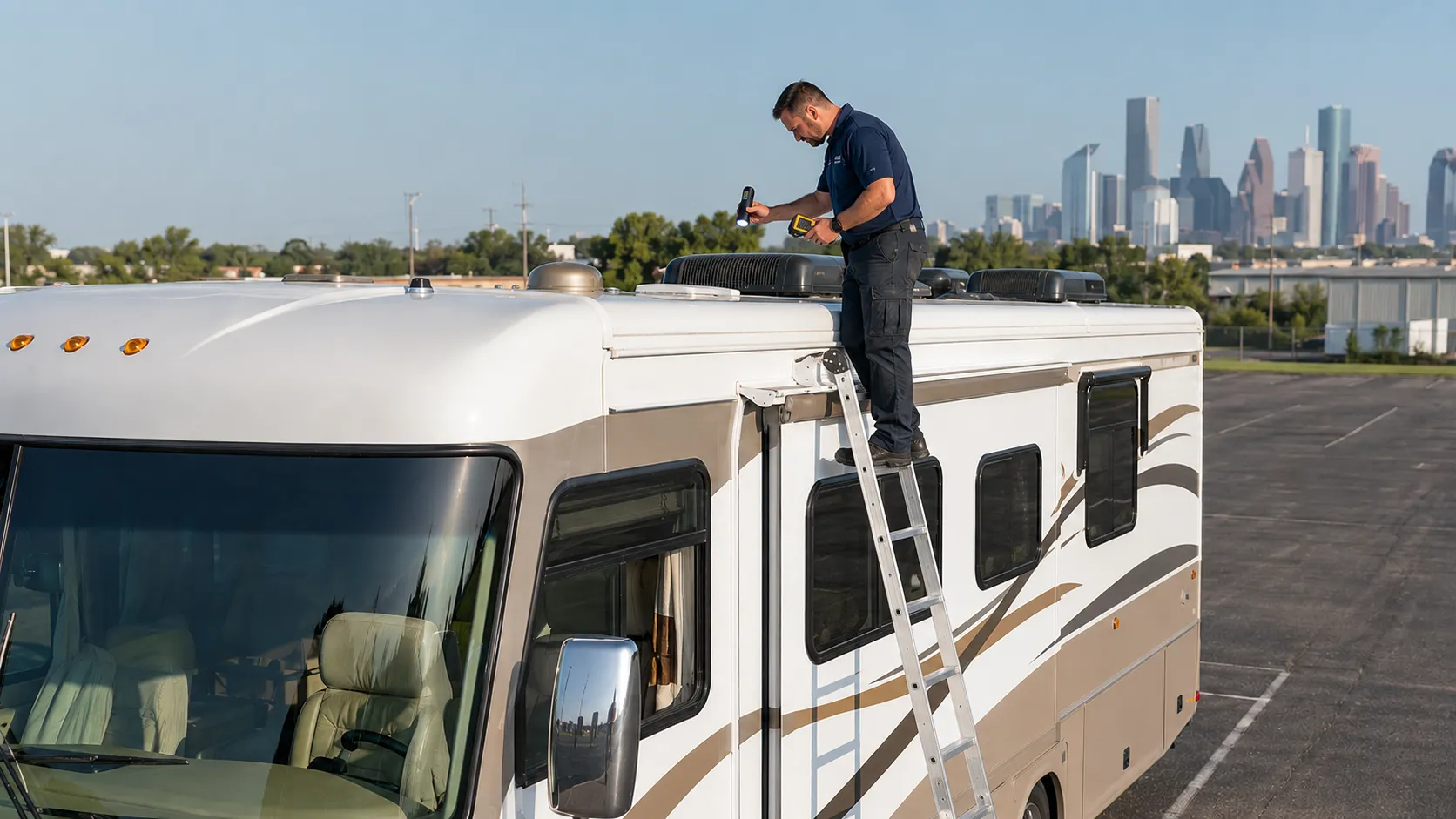
An RV inspection in Houston covers the vehicle chassis on motorhomes plus all living systems: roof condition and water intrusion, plumbing, electrical, propane, HVAC, appliances, and slide-out operation. The Gulf Coast’s intense UV, sustained humidity, and hurricane history make water damage the most common and most expensive finding on Houston-area RVs. Pre Purchase Auto Inspections LLC performs RV inspections across the Houston metro at $279.99, mobile service included.
Houston is prime RV country. Galveston Island, Brazos Bend State Park, Matagorda Bay, and the Bolivar Peninsula are all within an hour’s drive. The Gulf Coast’s year-round mild winters make RV ownership practical for more months per year here than in most of the country.
But the same Gulf Coast environment that makes Houston great for RVing is brutal on the vehicles themselves. Intense UV breaks down roof membranes faster than almost any other market. Sustained humidity infiltrates slides, cabinetry, and electrical systems. Salt air corrodes metal components. A/C units run so hard through Houston’s summers that they wear out ahead of schedule.
A RV inspection Houston before you buy catches what sellers often don’t disclose and what the average buyer walking through a rig would never know to look for. Here is what it covers.
How an RV Inspection Differs From a Car Inspection
Buying a used RV is buying a vehicle and a home simultaneously. The inspection reflects that.
A standard pre purchase inspection on a passenger car checks the engine, transmission, brakes, suspension, and electrical systems. An RV inspection does all of that for the chassis and drivetrain on motorhomes – and then keeps going. According to the National RV Inspectors Association, a comprehensive RV inspection covers structural integrity, all living systems, and every safety-critical component that a standard vehicle check never touches.
That includes the roof, the plumbing system, the electrical shore power and battery systems, the propane lines and appliances, the HVAC, the slide-outs, and all interior living surfaces. An RV in poor condition can look fine from the driver’s seat and be harboring $15,000 in water damage in the walls.
The Roof: The Single Most Important Check on Any RV
Every experienced RV inspector starts on the roof. It’s the most vulnerable component on any RV, and water entering through the roof is responsible for the majority of expensive RV repair bills.
RV roofs use rubber membranes – EPDM or TPO – with sealant applied around every penetration: air conditioning units, vent fans, antennas, running lights, and rooftop accessories. In Houston’s UV environment, that sealant breaks down faster than in most markets. Cracked, dried, or missing sealant lets water into the wall cavity, where it spreads silently before any interior sign appears.
The roof inspection checks the membrane condition across the full surface, probes for soft spots indicating water-saturated underlying decking, and evaluates every penetration seal individually. A soft spot anywhere on the roof surface indicates that water has already worked through the membrane and into the wood substrate.
The sidewalls tell the next part of the story. Delamination – the separation of the fiberglass outer wall from the foam core and inner wall – happens when water infiltrates the wall cavity and breaks down the adhesive bonding the layers. It shows as bubbling, waviness, or a soft section in the wall panel.
Delamination doesn’t repair itself. Small localized areas can be addressed relatively affordably. Widespread delamination across multiple wall sections often makes the repair cost exceed the RV’s value.
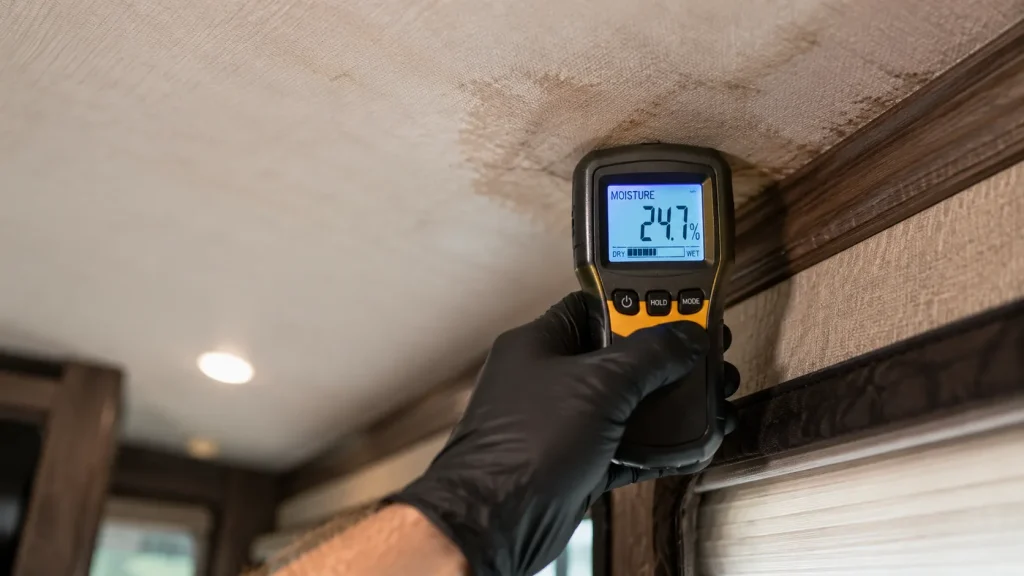
Water Damage Repair Costs: What You’re Looking at If the Inspection Finds It
Water damage is not a minor inconvenience on an RV. Here is what the repair costs look like depending on what the inspection finds:
| Water Damage Issue | How to Spot It | Typical Repair Cost |
|---|---|---|
| Minor roof sealant failure | Cracked or dried caulk around vents, AC units, and roof penetrations | $200-$800 |
| Active roof leak with ceiling damage | Staining or soft spots on ceiling panels, discolored interior ceiling | $800-$3,000 |
| Delamination – localized sidewall sections | Bubbling, waviness, or separating layers on fiberglass wall panels | $2,000-$8,000 |
| Widespread sidewall delamination | Multiple panel areas with bubbling, soft spots along the full wall length | $10,000-$20,000+ |
| Roof membrane replacement (EPDM/TPO) | UV chalking, persistent leaks despite sealant repair, membrane cracking | $6,000-$20,000+ |
| Floor rot from sustained water intrusion | Soft or spongy floor areas, particularly near the slide-out edges | $2,000-$8,000 |
In Houston specifically, the roof membrane replacement costs trend toward the higher end of those ranges because most Gulf Coast RVs have been subjected to more UV hours and humidity cycles than the same RV from a northern or inland market.
If a seller claims the roof was recently resealed or repaired, a follow-up inspection for $99 lets you verify the work was actually completed correctly before any money changes hands.
What the Full RV Inspection Covers
Beyond the roof and water damage check, the inspection evaluates every major system.
Here is what gets checked:
⦁ Roof condition: membrane integrity, sealant at all penetrations, soft spots, and any active leak evidence
⦁ Sidewalls and floor: delamination detection, soft spot probing, floor integrity especially near slide-out edges
⦁ Slide-outs: operation cycle through full extension and retraction, seal condition on all sides, floor condition inside the slide
⦁ Electrical: shore power connection and GFCI outlets, battery bank condition and charging system, converter/inverter function, all 12V and 120V circuits
⦁ Plumbing: fresh water pump operation, all faucets and fixtures, hot water heater, toilet, and grey and black tank function and valve condition
⦁ Propane: regulator condition, line integrity, all propane appliances (stove, oven, water heater, furnace) tested for proper operation
⦁ HVAC: rooftop air conditioner output and cycling, furnace operation, thermostat function
⦁ Appliances: refrigerator (both AC and propane modes where equipped), microwave, entertainment systems
⦁ On motorhomes – chassis and drivetrain: engine condition and cold start, transmission, brakes, tires, suspension, OBD-II diagnostic scan
⦁ On towables – hitch and running gear: hitch coupler condition, safety chains, brake controller connection, all running lights, tire condition and age codes, wheel bearing condition
Houston-Specific RV Risks
Several risk factors specific to the Houston Gulf Coast market deserve extra attention on any used RV inspection here.
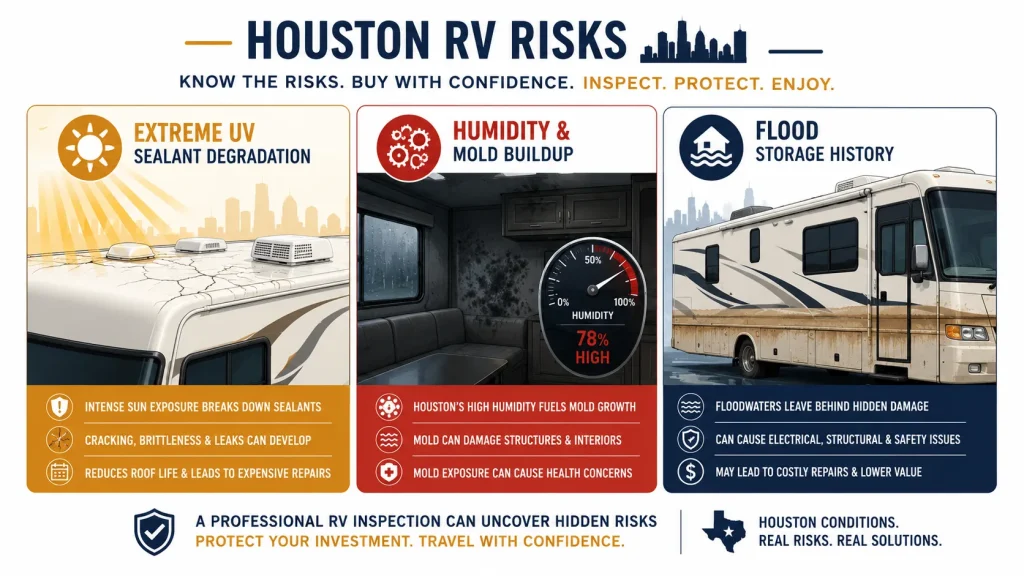
⦁ UV roof degradation: Houston averages over 2,500 hours of sunshine per year, and the Gulf Coast humidity amplifies UV effects on rubber membranes – expect faster roof degradation than in comparable northern or mountain-market RVs of the same age
⦁ Humidity inside slides and cabinetry: Gulf Coast humidity levels create ideal conditions for mold and mildew inside slide-out rooms and enclosed cabinet spaces, especially in RVs that sat unused between camping seasons
⦁ Salt air corrosion on the undercarriage: RVs that made regular coastal camping trips near Galveston or along the Texas coast accumulate salt air corrosion on frame rails, hitch components, and underbelly mechanical connections
⦁ A/C unit overuse and wear: Houston’s six-month heat season means rooftop A/C units run more total hours per year than in most markets – compressors and capacitors fail earlier, and full A/C replacement ($1,200-$2,000 per unit) is a common inspection finding
⦁ Hurricane and flood damage from Harvey and subsequent storms: thousands of RVs were damaged or flooded in the Houston area during Harvey and in subsequent seasonal flooding – a flooded RV has sustained damage to electrical systems, underbelly components, and interior materials that is extremely difficult to fully remediate
⦁ Deferred maintenance from seasonal storage: Houston’s mild winters mean some owners use their RVs year-round but skip annual roof resealing and sealant maintenance – the inspection specifically checks whether this routine maintenance has been kept up
For commercial units, fifth wheels used as mobile offices, or work trucks with camper bodies, Pre Purchase Auto Inspections LLC also offers commercial vehicle inspection services covering the full vehicle.
Frequently Asked Questions
How is an RV inspection different from a standard vehicle inspection?
An RV inspection covers the vehicle systems – engine and chassis on motorhomes, hitch and frame on towables – plus the living systems that have no equivalent in a passenger car: plumbing, propane, electrical shore power and battery, HVAC, appliances, slide-outs, and the roof and wall structure. The roof and water intrusion check is the most critical component and has no parallel in a standard vehicle inspection.
What is the most common expensive problem found on used RVs?
Water damage is the number one costly finding on used RVs. It typically begins with failed sealant around roof penetrations, then works into the wall cavity causing delamination. Localized delamination costs $2,000-$8,000 to repair. Widespread delamination can reach $10,000-$20,000 or more. In Houston, the combination of intense UV, humidity, and storm history accelerates these failure patterns significantly.
How long does an RV inspection take?
An RV inspection takes 90 minutes to 2 hours on a typical travel trailer or fifth wheel. Large Class A motorhomes run 2 to 3 hours because of the additional mechanical systems and the greater surface area of roof, walls, and slide-outs to evaluate. The written report with photos is delivered the same day.
Does a Houston RV inspection cover the engine as well as the living systems?
Yes, on motorhomes. A Class A, B, or C motorhome inspection covers both the chassis and drivetrain – engine condition, transmission, brakes, tires, and a full OBD-II diagnostic scan – and all of the living systems: roof, plumbing, electrical, propane, HVAC, appliances, and slide-outs. Travel trailers and fifth wheels have no engine to check. Those inspections focus on the frame, hitch, tires, brakes, and living systems.
How much does an RV inspection cost in Houston?
An RV and Camper Inspection from Pre Purchase Auto Inspections LLC costs $279.95. This covers the full inspection including roof and water intrusion assessment, slide-out evaluation, plumbing, electrical, propane systems, appliances, chassis and frame, and a road test or tow-out where applicable. The inspection comes to the RV anywhere in the Houston metro. Call (346) 644-6168 or order an inspection online to schedule.
Book Your Houston RV Inspection Today
Pre Purchase Auto Inspections LLC comes to the RV – at the dealer in Alvin, a private seller’s property in Pearland or Katy, or anywhere across the Houston metro. Same-day scheduling on most requests.
(346) 644-6168 | order an inspection online
RV and Camper Inspection: $279.99 | Mobile – we come to the vehicle
Get a Pre Purchase Auto Inspection Today