How to Check If a Car Has Been in an Accident
|
How to Check If a Car Has Been in an Accident: 6 Methods That Actually Work
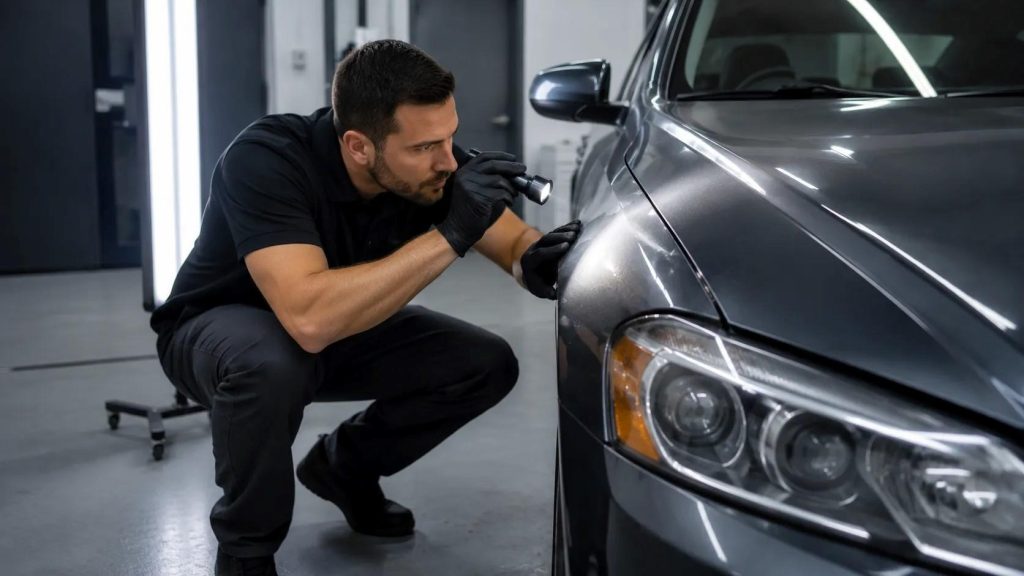
Checking if a car has been in an accident requires six methods: a vehicle history report for officially recorded incidents, a paint thickness gauge to detect hidden body filler over repaired panels, a panel gap inspection for collision repairs that didn’t restore original tolerances, an airbag system OBD scan for deployed or disconnected airbags, a frame and unibody check for weld repairs or structural straightening, and an under-hood inspection for replaced or mismatched components. CarFax alone misses approximately 1 in 6 accidents.
An estimated 1 in 6 used vehicles has accident damage that doesn’t appear in its CarFax report, according to CarFax’s own market data. That’s not a criticism of the service – it’s a structural limitation. CarFax captures what gets officially reported. Most low-to-moderate speed accidents between private parties never trigger an insurance claim or police report.
The result is a significant gap between the documented history of a vehicle and its actual accident history. Closing that gap requires methods that go beyond the database and onto the physical car.
Here are the six checks that reveal accident history – what each one finds and what it misses.
The 6 Methods for Checking Accident History on a Used Car
| Check Method | What It Reveals | What It Misses |
|---|---|---|
| CarFax / AutoCheck | Reported accidents, insurance claims, airbag deployments from official records | Cash repairs, unreported incidents, and any accident where insurance wasn’t involved |
| Paint thickness gauge | Bondo or thick filler over repaired panels, repaints that don’t match factory paint depth | Repairs done with original factory panels rather than filler |
| Panel gap inspection | Collision repairs that didn’t restore original tolerances – gaps wider or tighter on one side | Minor repairs on replaceable panels that fit precisely |
| Airbag system scan | Deployed or disconnected airbags, SRS fault codes, airbag warning light causes | Airbags that were replaced but with faulty or aftermarket units |
| Frame and unibody check | Weld repairs, pulled or straightened frame rails, kink marks in subframe | Internal cracking in unibody structures that requires disassembly to detect |
| Under-hood inspection | Mismatched bolts, replaced components, fresh paint in areas that don’t normally get painted | Repairs to components not visible during a walk-around inspection |
Method 1: Vehicle History Report (Start Here, Don’t Stop Here)
Run a CarFax or AutoCheck report on any vehicle before you spend time on an in-person inspection. If the report shows reported accidents, airbag deployments, or structural damage – use that information to guide where the physical inspection focuses.
But the report is a starting point, not a conclusion. Cash repairs between private parties generate no insurance claim. Accidents that occur in states with limited reporting requirements may not transfer to the vehicle’s CarFax when it’s titled in Texas. The 1-in-6 miss rate is real and consistent.
In Houston specifically, the flood damage limitation applies the same way to accidents. A Harvey-damaged vehicle that was privately repaired without an insurance claim may have a clean CarFax despite significant damage history.
Method 2: Paint Thickness Gauge
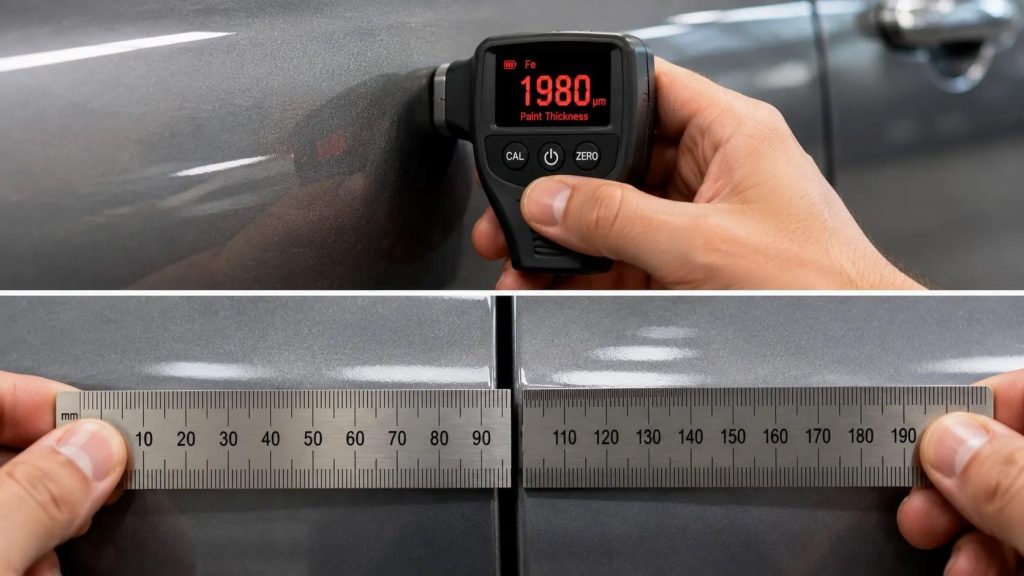
The paint thickness gauge is the most reliable single tool for detecting prior accident repair. It measures the depth of the paint and any underlying filler at multiple points across each body panel.
Factory-applied paint reads consistently thin across all panels on the same vehicle – typically 4 to 5 mils. A panel repaired with body filler and repainted reads 10 to 20 mils or more. There is no way to disguise this with a respray, regardless of how perfect the paint looks from the outside.
Here is how to interpret the readings:
- Consistent thin readings across all panels: factory or professional restoration paint, no filler
- One or two panels reading significantly thicker than the rest: localized repair – likely a single impact or corner damage
- Multiple panels reading thick, especially in a pattern consistent with a front or rear impact: more significant collision repair
- Extremely thick readings at panel edges near door jambs or wheel arches: rust has been filled over rather than cut out and replaced
Method 3: Panel Gap Inspection
Every factory-built vehicle has specific panel gaps between the hood and fenders, doors and sills, trunk lid and quarter panels. These gaps are set by the manufacturing process and should be consistent left-to-right on the same vehicle.
A collision that required frame or panel repair almost always changes these gaps on the affected side. A gap that is 5mm wider on the driver’s side hood-to-fender joint than on the passenger side tells you the front end was repaired – even if the paint looks perfect.
The inspection does this by measuring or visually comparing gap widths on both sides from the same distance and angle. Look for:
- Gaps that are visibly wider or narrower on one side versus the other
- Panels that sit higher or lower than the adjacent panel across a gap
- Wavy or inconsistent gaps along the length of a door or hood – indicates panel replacement that didn’t align perfectly
Method 4: Airbag System Scan
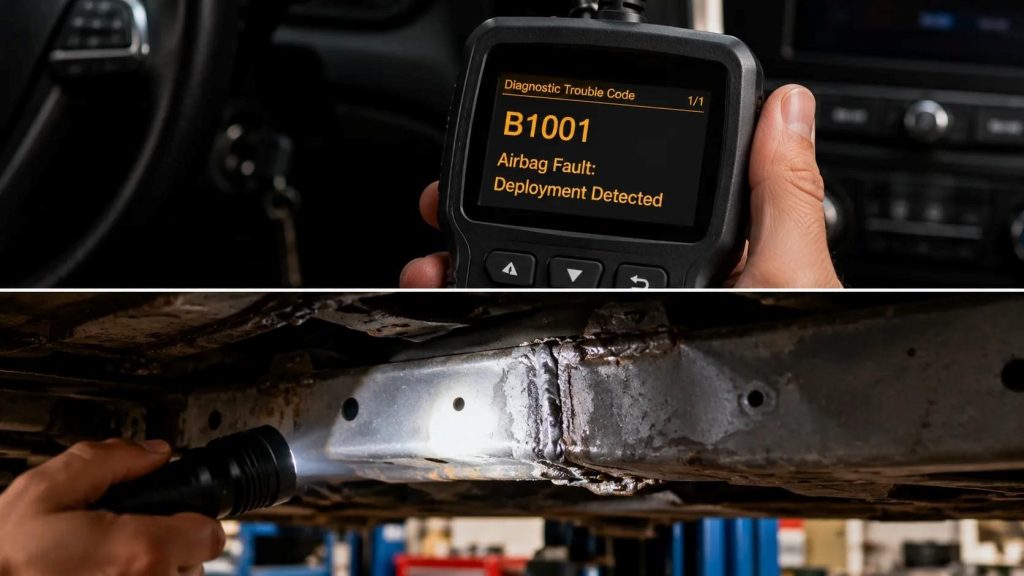
A deployed airbag leaves a permanent record in the SRS (Supplemental Restraint System) module. This record persists even when the airbag has been replaced. The OBD scan of the SRS module is the only way to see this history without disassembly.
The dashboard airbag warning light is an insufficient check on its own. Some sellers reconnect the warning light circuit without properly replacing or resetting the airbag system. The light goes off on startup, but the SRS module still carries the fault record.
An airbag that was deployed in a collision and replaced with an aftermarket or salvage unit rather than a new OEM unit is a safety concern that no amount of cosmetic repair resolves. The SRS scan catches this.
Method 5: Frame and Unibody Check
Structural damage to the frame or unibody is the most serious accident finding and the one that most directly affects the vehicle’s long-term safety and value.
On body-on-frame trucks and SUVs, the frame rails are inspected for kinks, weld repairs, and pulling marks from collision straightening equipment. On unibody vehicles – which is most modern passenger cars – the inner sills, floor pan, and firewall are checked for deformation, weld repairs, and structural repairs that were never designed to be done in the field.
Fresh undercoating applied selectively to specific areas of the undercarriage – rather than uniformly across the whole underside – often indicates a frame or floor pan repair was recently concealed.
Method 6: Under-Hood Inspection
The engine compartment tells a different story than the exterior. Accidents that damage the front end often affect components in the engine bay that are replaced but not perfectly matched:
- Mismatched or replaced bolts in the hood hinge area, fender bolts, or radiator support mounting points
- Fresh paint on the firewall or inner fender areas that doesn’t match the paint depth on the rest of the engine compartment
- A replaced radiator, condenser, or cooling system component inconsistent with the vehicle’s stated service history
- Weld marks or creases in the inner fender structure not present on the opposite side
- Overspray on wiring harness clips, hose clamps, or other components that would be masked before a factory paint application but not before a field repair
How These Checks Work Together
No single check catches everything. But the combination creates a complete picture.
A vehicle with a clean CarFax, consistent panel gaps, and factory-depth paint readings across all panels is almost certainly accident-free. A vehicle with a clean CarFax but thick paint on two panels, a gap inconsistency on the driver’s side, and a replaced headlight bolted with mismatched hardware has been in a collision that was never reported.
The pre purchase auto inspection runs all six checks in a single visit to the vehicle. The written report documents every finding with photos – showing exactly which panels read thicker than factory, where gaps are inconsistent, and what the airbag module shows. That report is the documentation you need to negotiate or walk away.
Frequently Asked Questions
How can I tell if a used car has been in an accident?
The most reliable methods are a paint thickness gauge to detect body filler over repaired panels, panel gap inspection to find collision repairs that didn’t restore original tolerances, an airbag system OBD scan to check for deployed or disconnected airbags, and a vehicle history report for officially recorded accidents. A professional pre purchase inspection combines all of these checks into a single evaluation.
Can a car look perfect and still have accident damage?
Yes. A skilled body shop can make a severely damaged vehicle look showroom-quality. The paint thickness gauge catches repainted or filled panels regardless of cosmetic appearance. Internal structural damage is harder to detect visually. Airbag deployment leaves evidence in the SRS module even after the airbag system has been replaced. A professional inspection catches what the eye misses.
What does a CarFax miss when checking accident history?
CarFax only records accidents reported through insurance claims, police reports, or state DMV records. Cash repairs between private parties generate no record. Accidents in states with limited reporting requirements may not appear. An estimated 1 in 6 used vehicles has accident damage not in its CarFax report.
What is a paint thickness gauge and how does it detect accident history?
A paint thickness gauge measures the depth of paint and any filler beneath it at each panel. Factory paint reads consistently thin – typically 4 to 5 mils. A panel repaired with body filler reads 10 to 20 mils or more. The gauge makes it impossible to hide a repainted or filled panel regardless of paint quality.
How do I check if a car’s airbags were deployed in an accident?
The airbag warning light is a starting point but insufficient alone. The reliable check is an OBD-II scan of the SRS airbag module, which carries a permanent record of any airbag deployment even after replacement. Call (346) 644-6168 or order an inspection online to schedule a complete accident history evaluation in Houston.
Find Out Exactly What the Car Has Been Through
Pre Purchase Auto Inspections LLC brings every accident detection method to the vehicle – paint thickness gauge, airbag system scan, frame check, and full OBD multi-module scan. Mobile service across Houston.
Get a Pre Purchase Auto Inspection Today