What to Look for When Buying a Used Car in Houston
|
What to Look for When Buying a Used Car in Houston
When buying a used car in Houston, look for flood damage indicators (musty smell, carpet moisture, engine bay silt), paint inconsistency across panels suggesting prior repair, panel gap differences left versus right, document issues including out-of-state title registration, and transmission and brake behavior on a cold test drive. Houston’s specific risks – 29,000+ circulating flood vehicles, Gulf Coast humidity, and title-washed Harvey cars – make these checks more critical here than in almost any other US market.
Houston is one of the largest and most competitive used car markets in the country. CarGurus’ 2026 Houston market analysis shows the metro averages 35% Good or Great Deal listings across its used car inventory – a result of the sheer number of sellers competing for buyers in a massive market.
But Houston’s size and volume create a specific problem that doesn’t exist at the same scale anywhere else in the US. More circulating inventory means more opportunity for misrepresented vehicles to blend in. And Houston’s Gulf Coast position means flood damage, humidity, and Harvey’s lingering vehicle legacy add layers of risk that buyers in Dallas or San Antonio simply don’t face.
Here is a complete guide to what to look for when buying a used car in Houston – organized by stage, with the Houston-specific risk at each step.
The Houston Used Car Buyer’s Walk-Around: What to Check at Each Stage
| Buying Stage | What to Look For | Houston-Specific Risk |
|---|---|---|
| Online research | Price vs comparable listings on CarGurus or Edmunds. Seller contact details. Time listed. | Houston’s large market creates real below-market deals – but a price 15%+ below comparable listings almost always has a reason you need to find before you go |
| Exterior walk-around | Paint consistency across all panels at low angle. Panel gap widths compared left vs right. Overspray on door seals or trim. | Harvey flood cars get fresh paint to conceal rust and water damage repairs. A paint thickness gauge reveals body filler no visual check can catch |
| Interior check | Press carpet beneath every floor mat for moisture. Smell the air when you first open the door. Tide line stains at a consistent height on door panels. | Houston has 29,000+ flood-damaged vehicles actively circulating. Musty smell and carpet moisture are the two most reliable flood indicators |
| Engine bay | Oil color and condition on the dipstick. Coolant level and color. Mud or silt in crevices around the starter, wiring harness, and behind accessories. | Flood events leave fine silt deposits in the engine bay that road dirt never reaches. A clean engine bay on a flooded car usually means a pressure wash, not no flood |
| Undercarriage | Rust pattern and depth on frame rails. Fresh undercoating applied to specific areas rather than uniformly. Drain plug tool marks. | Gulf Coast humidity accelerates undercarriage rust significantly faster than dry climates. Rust inconsistent with the vehicle’s age and stated location history is a red flag |
| Documents | VIN on title matches VIN on dash and door jamb. Title in seller’s name. No Flood, Salvage, or Rebuilt branding. State of last registration. | Title-washed Harvey vehicles are often re-registered in Louisiana, Florida, or Georgia to remove flood branding before coming back to Houston |
| Test drive | Cold start behavior. Transmission response from a standing stop. Brake pedal feel. Any warning lights that appear while driving. | Sellers who start the engine before you arrive are hiding a cold-start problem. Always arrive early enough to test a cold engine |
The table above organizes the buyer’s journey from online research through the test drive. Each stage has both a general check and a Houston-specific risk that elevates the stakes locally. The rest of this guide goes deeper on the three stages that matter most.
Before You Go: What to Check Online
The most time-efficient filter in used car buying happens before you ever drive to see the vehicle. Two things to verify online before making an appointment:
First, run the VIN through a vehicle history report. CarFax and AutoCheck both offer this for around $25-50. Look for reported accidents, flood branding, odometer discrepancies, number of owners, and whether the vehicle was recently re-registered from another state. A car that was titled in Louisiana last month and is now listed in Houston is worth a much harder look.
Second, compare the asking price to at least five comparable listings on CarGurus or Edmunds – same make, model, year, and approximate mileage. If the listing is significantly below market, the question isn’t whether it’s a deal. It’s what the seller knows that you don’t yet.
What to Look for Outside the Car
Your goal on the exterior walk-around is to read what the car has been through – not what it looks like from a few feet away at a favorable angle.
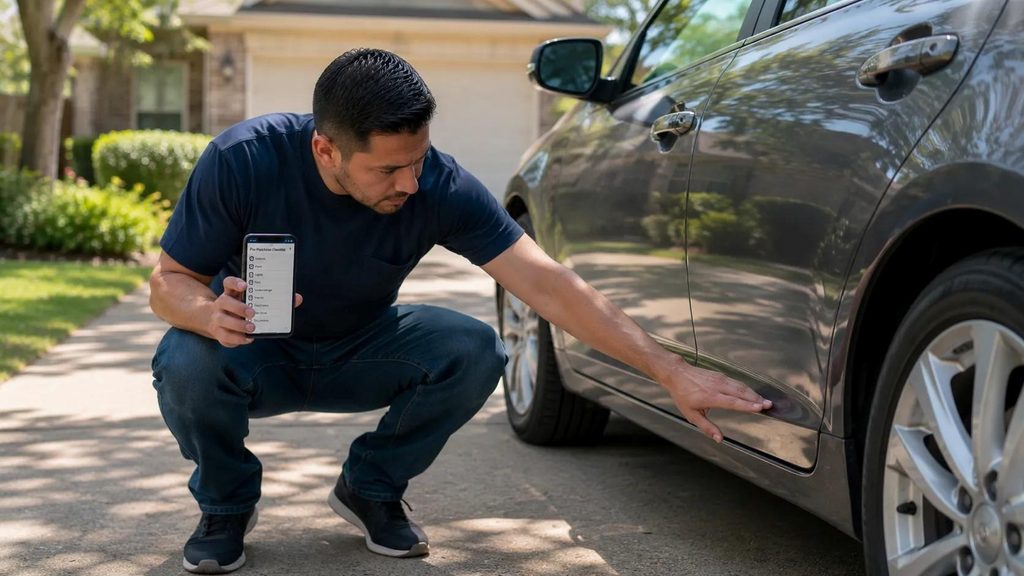
Start at one end and crouch down so you’re looking along the body line of the car toward the other end. Paint inconsistencies, slight waviness in a panel, or a mismatched sheen on one door become obvious from this angle. They’re nearly invisible standing upright.
Then check the panel gaps. The space between the hood and both fenders should be consistent. The gap between each door and the sill should match its pair on the other side. A gap that’s visibly wider or tighter on one side than the other is a mechanical consequence of a collision repair that didn’t fully restore the original tolerances.
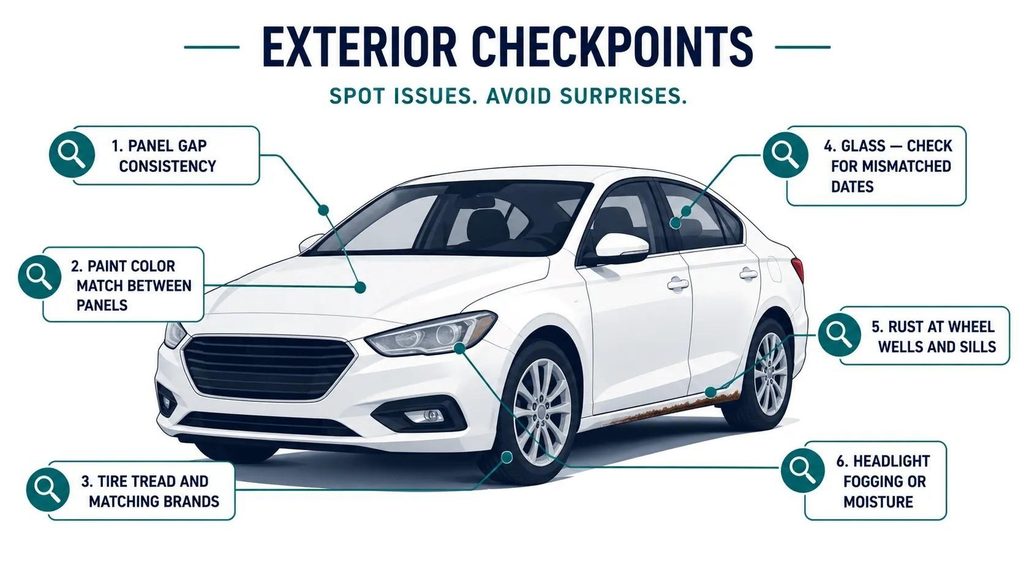
Alt Text: Exterior used car inspection checklist diagram showing six checkpoints including panel gaps, paint match, tires, glass, rust, and headlights
Here is what you’re looking for on the exterior:
- Panel gaps: measure or visually compare the hood-to-fender and door-to-sill gaps on both sides – any inconsistency indicates prior collision work on the uneven side
- Paint consistency: look for subtle differences in sheen, texture, or color depth between adjacent panels – resprayed panels have a slightly different look than original factory paint
- Overspray: check the door jambs, weather seals, and trim pieces for flecks of paint that shouldn’t be there – these appear in field repairs and indicate non-factory bodywork
- Rust at the door bottoms: open every door and look at the lower seam from below – rust forming from the inside of the seam is an early indicator of structural corrosion
- Light housings: look inside the headlight and taillight lenses for condensation, water stains, or a visible tide line – these are flood indicators even with no external damage
What to Look for Inside the Car
Before you sit down, open the door and stand back for five seconds. Smell the air from outside the car before getting in. A musty or mildew smell is the single most reliable flood indicator, and it’s more noticeable from a standing position before your nose adjusts to the interior.
Once inside, press down firmly on the carpet beneath every floor mat. New carpet is a red flag by itself – replacing carpet on a vehicle that’s five or more years old only happens for a reason. If the carpet is original and it’s wet or damp beneath the mat, that’s direct evidence of water intrusion.
Check the seat rails and mounting bolts. These metal components are not normally exposed to water in a well-maintained vehicle. Rust or corrosion on seat rail bolts specifically – not just on surface metal – indicates the interior was submerged.
What to Look for in the Documents
Most buyers spend less than two minutes on the documents. This is where some of the most consequential problems hide.
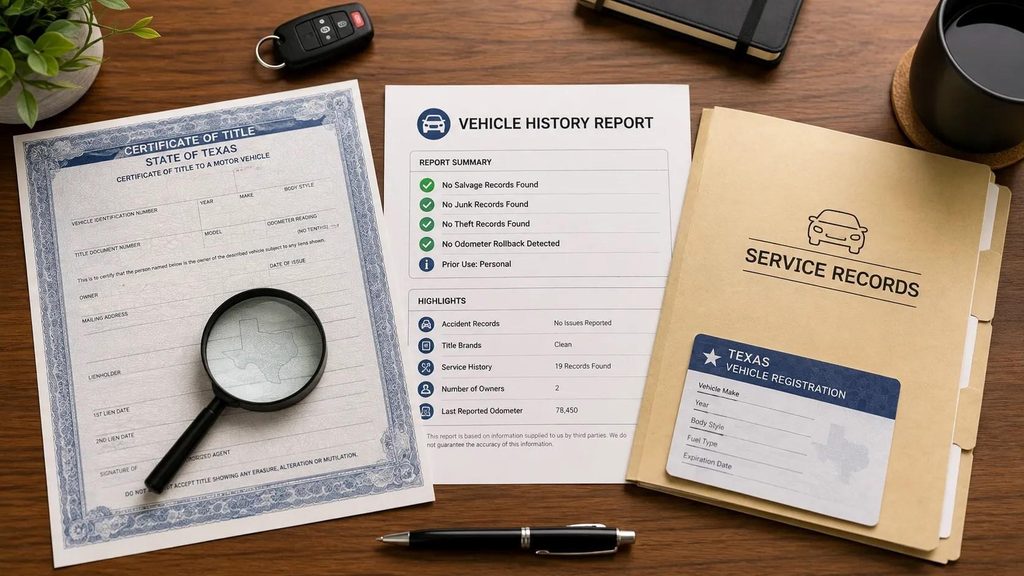
Alt Text: Used car documents on a desk including title, vehicle history report, and service records with a magnifying glass for inspection
Pull up three pieces of information and cross-reference them:
- The VIN on the dashboard: visible through the lower corner of the windshield on the driver’s side – photograph it before you do anything else
- The VIN on the driver’s door jamb: should be a sticker on the B-pillar or door jamb area – must match the dashboard VIN exactly
- The VIN on the title: pull the physical title and compare it character by character – a VIN mismatch between any two of these three locations is a serious flag
- The title state: look at where the vehicle was last titled – if it was recently re-registered in Texas from Louisiana, Florida, or Georgia without a clear history explaining the move, run the VIN through a history report and look specifically for flood or salvage events in that state
- Title branding: the words Flood Damage, Salvage, or Rebuilt must appear on the title if the vehicle was officially designated for any of these – their absence doesn’t guarantee a clean history, but their presence is definitive
What to Look for on the Test Drive
Always insist on a cold start. Tell the seller you’ll arrive at a specific time – a seller who has the car running when you show up is hiding a cold-start problem. An engine that struggles to start, idles rough for the first minute, or produces visible smoke on a cold start is telling you something the warm-running version won’t.
Here is what to check on the test drive itself:
- Transmission engagement from a full stop: put the car in drive from park and feel for hesitation, a slip, or a clunk before the car moves – normal engagement is smooth and immediate
- Brake pedal feel: at moderate speed, apply the brakes firmly – a pedal that pulsates indicates warped rotors; a pedal that sinks slightly indicates a brake system issue worth investigating
- Steering response: any pull to one side during straight-line driving points to alignment issues; a slight tug under acceleration in a front-wheel-drive car is normal, but severe pull is not
- Transmission at highway speed: accelerate to 60-65 mph if possible and hold steady speed, then let off the gas – a transmission that’s hunting for gears or shifting erratically under these conditions is wearing out
- Warning lights: note any dashboard lights that appear during the drive, and do not accept the seller’s explanation at face value – any active warning light warrants a code read before you buy
- Noise during the drive: listen for any clunking from the suspension over bumps, grinding from the brakes, or vibration through the steering wheel at speed
Why the Walk-Around Is Only the First Filter
A thorough personal walk-around eliminates obvious problems and tells you whether a car is worth investing further time and money in. But it can’t do everything.
You can’t read stored OBD fault codes. You can’t put the car on a lift to check the undercarriage from below. You can’t run a paint thickness gauge on every panel to detect body filler. You can’t check brake pad thickness on all four corners. And in Houston specifically, you can’t run the wire harness and drain plug checks that catch a flood-remediated vehicle that looks perfectly clean from the interior.
That’s what a professional inspection covers. A pre purchase auto inspection from Pre Purchase Auto Inspections LLC goes to the vehicle wherever it is in the Houston metro and runs every check your walk-around can’t. You get a same-day written report with photos before you make any commitment.
If a seller agrees to fix something before you close, a follow-up inspection at $99 verifies the work before any money changes hands.
Frequently Asked Questions
What should I look for when buying a used car in Houston?
When buying a used car in Houston, look for flood damage indicators (musty smell, carpet moisture, tide lines, engine bay silt deposits), paint consistency across all panels, panel gap inconsistencies suggesting collision repair, document issues including title state of origin and VIN verification, and transmission and brake behavior on a cold test drive. Houston’s specific risks include 29,000+ circulating flood vehicles, Gulf Coast humidity accelerating undercarriage rust, and title-washed Harvey vehicles re-registered from out of state.
How do I check for flood damage when buying a used car in Houston?
Open the car door and stand back before getting in – a musty or mildew smell is the most reliable single indicator. Press the carpet beneath every floor mat for moisture. Look for water stain tide lines at a consistent height on door panels and center console. Check the engine bay for fine silt deposits in crevices that road dirt would never reach. Check the headlight and taillight housings for internal moisture. And verify the title was not recently re-registered from another state – a common route for title-washed Harvey vehicles.
What documents should I check when buying a used car in Houston?
Cross-reference the VIN on the dashboard, the VIN on the driver’s door jamb, and the VIN on the title – all three must match exactly. Confirm the title is in the seller’s name. Look for Flood, Salvage, or Rebuilt branding on the title. Note where the vehicle was last registered – recent re-registration from Louisiana, Florida, or Georgia to Texas often indicates flood or salvage history removed through title washing.
What should I listen for on a test drive of a used car?
Start with a cold engine. Listen for engine knock or tick at idle. Feel for delayed transmission engagement from a complete stop. Check brake pedal firmness and whether it pulses when stopping. Note any warning lights that appear while driving. A rough idle that smooths out after a few minutes suggests the seller pre-warmed the engine to hide a startup problem.
What is the most important step when buying a used car in Houston?
An independent pre purchase auto inspection by a mobile inspector who comes to the vehicle. Your walk-around is the first filter. But a walk-around cannot read OBD fault codes, run a paint thickness gauge, check brake pad thickness on all four corners, or inspect the undercarriage properly. Call (346) 644-6168 or order an inspection online – we come to the vehicle anywhere in the Houston metro. Standard Inspection: $159.99.
Get a Professional Second Opinion on Any Houston Used Car
Your walk-around is the first filter. A professional inspection is the verification. Pre Purchase Auto Inspections LLC comes to the vehicle anywhere in Houston, Katy, Sugar Land, Pearland, The Woodlands, Pasadena, and Cypress.
Get a Pre Purchase Auto Inspection Today