What to Do If a Pre Purchase Inspection Finds Problems
|
What to Do If a Pre Purchase Inspection Finds Problems

Sort inspection findings into four categories: walk-away issues, major problems requiring hard renegotiation, moderate items worth negotiating, and minor items to note and move past. Structural rust, undisclosed flood damage, and frame repair are walk-away findings that no discount resolves. Most other findings are negotiating points – convert them to dollar figures with written repair estimates and request a price reduction.
The report came back and it isn’t clean. Now what?
First: this is normal. Most inspections on used vehicles find something. A car with 80,000 miles and no findings at all would be unusual. The relevant question isn’t whether the report is clean – it’s what the findings mean and what they cost.
The mistake most buyers make at this point is emotional rather than analytical. Either they panic and abandon a perfectly good car over $600 of brake work, or they talk themselves into a vehicle with structural problems because they’ve already imagined owning it. Here’s how to sort findings properly.
Sort Every Finding Into One of Four Categories
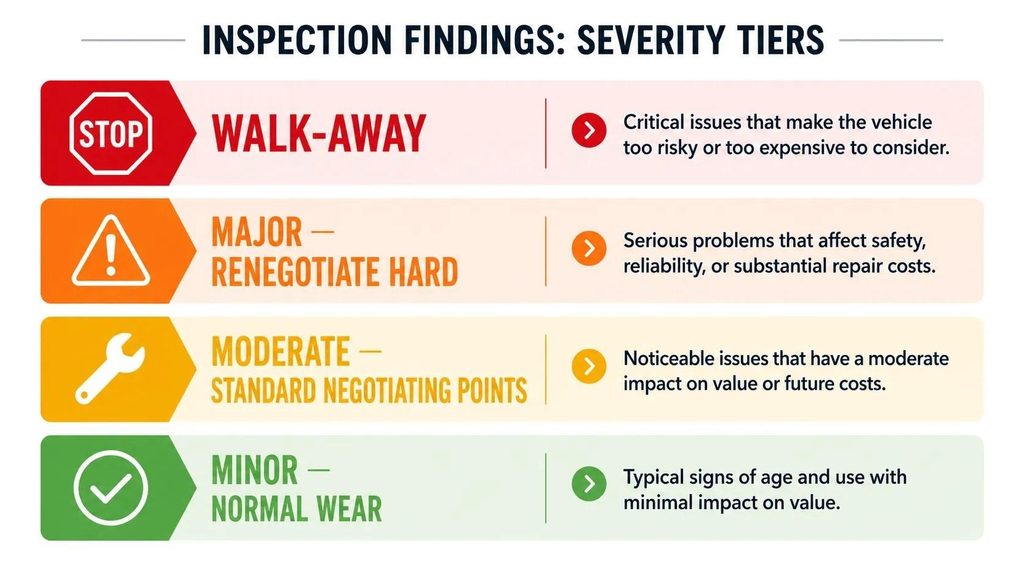
Alt Text: Four-tier severity framework for sorting pre-purchase inspection findings from walk-away issues to normal wear
Not all findings carry the same weight. Before you do anything else, categorize what the report actually says.
| Finding Category | Examples | What to Do |
|---|---|---|
| Walk away | Structural rust in frame rails, undisclosed flood damage, welded frame repair, salvage history the seller denied | Do not buy at any price. These are safety and integrity issues no discount resolves. Thank the seller and move on. |
| Major – renegotiate hard | Transmission slipping, engine oil consumption above spec, timing belt overdue, air suspension failing | Get a written repair estimate. Either the price drops by the full repair cost or you walk. Do not accept a promise to fix. |
| Moderate – negotiate | Brake pads and rotors due, tires below 4/32, worn suspension bushings, fluid services overdue | Standard negotiating items. Convert to dollar figures and request the price reduction. Most sellers will move. |
| Minor – note and proceed | Cosmetic wear, small dings, cabin filter due, wiper blades, minor trim | Not worth negotiating over individually. Note them and factor into your overall view of how the car was maintained. |
The top row is the only one where the decision is already made. Everything below it is a negotiation with different amounts of leverage attached.
The Walk-Away Findings
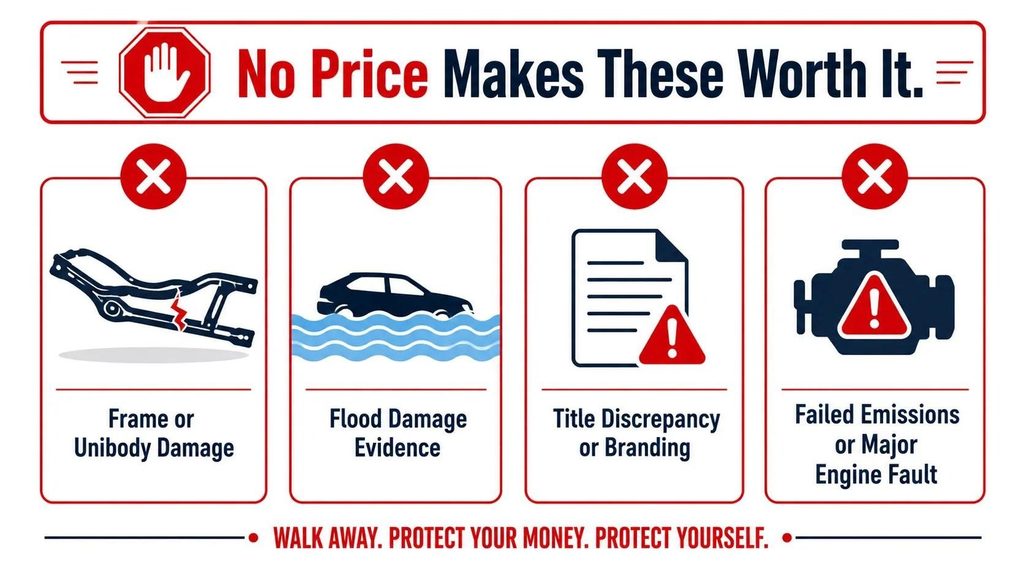
Alt Text: Four walk-away inspection findings illustrated including frame damage, flood evidence, title discrepancy, and major engine faults
Four findings should end the transaction regardless of how much you like the car or how far you’ve come in the process.
- Structural rust in load-bearing frame sections: the vehicle’s crash performance is compromised. Frame repair on a rust-compromised vehicle costs more than the car is worth, and a partial repair leaves you driving something with unknown structural integrity
- Undisclosed flood damage confirmed by physical inspection despite a clean title: the electrical failures come later and they compound. A flood car looks fine at the point of sale specifically because the damage develops over months
- Evidence of frame repair or weld work the seller did not disclose: this is both a safety concern and a disclosure failure. If the seller concealed this, consider what else they concealed
- Recently cleared fault codes on modules that should have been problem-free: the readiness monitor status shows the codes were cleared shortly before the sale. The seller knew about a problem and chose to hide it rather than disclose or fix it
None of these are negotiating positions. They’re conclusions. A discount doesn’t make a compromised frame safe, and a lower price on a flood car just means you overpaid slightly less for a vehicle that will fail expensively later.
The Major Findings: Renegotiate Hard or Walk
These are expensive but not disqualifying. The right approach is a written repair estimate and a firm position.
A transmission that slips during the road test, engine oil consumption above manufacturer spec, a timing belt past its service interval, or air suspension components beginning to fail – all of these carry repair costs in the $1,500 to $8,000 range depending on the vehicle. That’s not a rounding error on a used car purchase.
Get a written estimate. Then the position is simple: either the price comes down by the full repair cost, or you walk. This isn’t aggressive negotiating – it’s arithmetic. A car that needs $3,000 of work is worth $3,000 less than the same car that doesn’t.
Do not accept a seller’s promise to fix a major item without verification. On a $3,000 repair, the difference between a proper job and a cheap workaround is significant, and you have no way to know which you received once you’ve taken delivery.
The Moderate Findings: Standard Negotiating Points
This is where most inspection findings land, and where most of the value of the inspection gets realized.
Brake pads and rotors due for replacement. Tires below 4/32 tread. Worn suspension bushings. Transmission or brake fluid past service interval. Individually these are $200 to $800 items. Collectively on a neglected vehicle they can add up to $2,000 or more.
The approach: convert each item to a dollar figure with a written estimate, total them, and present the total as a price adjustment. Most sellers – particularly private sellers – will move on documented costs. They may not move the full amount, but the negotiation starts from a factual position rather than an opinion.
What makes these findings work as negotiating leverage:
- They’re objective and verifiable – a seller can take the car to their own shop and get the same assessment
- They’re immediate costs, not hypothetical future ones – brake pads at 15 percent need replacing now, not eventually
- They’re documented in writing with photos in the inspection report, which is harder to dismiss than a verbal claim
- The seller usually didn’t know about them, which means the negotiation isn’t adversarial – it’s both parties updating on new information
Price Reduction vs Seller Repair: Take the Money
When findings come back, many sellers offer to handle the repairs rather than reduce the price. Think carefully before accepting.
A price reduction gives you control over the shop, the parts, and the timeline. You know the work was done properly because you commissioned it.
A seller-performed repair gives you none of that. You don’t know which shop, whether they used OEM parts or the cheapest aftermarket option, or in some cases whether the work happened at all. On a private sale, your recourse after delivery is effectively zero.
If a seller insists on performing the repair, two conditions: get the commitment in writing with the specific work described, and verify it before any money transfers. A follow-up inspection at $99 confirms the specific repair was completed correctly. That’s exactly what that service exists for.
When the Findings Are Fine and the Price Is Right
Sometimes the analysis comes out in favor of buying. A car with $900 in deferred maintenance priced $2,500 below comparable listings is a good purchase – you’re paying for the condition you’re actually getting.
The inspection did its job in that scenario too. You now know what the first year of ownership costs, you can budget for it, and you’re not going to be surprised by a brake job three weeks after you buy.
That’s the real value of a pre purchase auto inspection – not finding a reason to walk away, but knowing exactly what you’re buying at the price you’re paying.
Set Your Walk-Away Number Before You Respond
Before you contact the seller with the findings, decide what your maximum price is.
The calculation is fair market value for a comparable vehicle in good condition, minus the documented repair costs. That’s your ceiling. If the seller meets it, buy the car. If they won’t, walk.
Make this decision before the conversation, not during it. Negotiating under pressure in a seller’s driveway with a car you’ve already imagined owning produces consistently worse outcomes than deciding the number in advance.
Frequently Asked Questions
What should I do if a pre purchase inspection finds problems?
Sort the findings into four categories: walk-away issues, major problems requiring hard renegotiation, moderate items worth negotiating, and minor items to note. Walk-away issues include structural rust, undisclosed flood damage, and frame repair – no discount resolves these. Major problems require a written repair estimate and either a full price reduction or walking. Moderate items are standard negotiating points.
Does a bad inspection mean I should not buy the car?
Not necessarily. Most inspections find something – the question is what and how much it costs. A car with $800 in deferred maintenance priced $2,000 below comparable listings may still be an excellent purchase. A car with structural rust or undisclosed flood damage is not a purchase at any price. The report gives you the information to make that distinction.
Can I ask the seller to fix the problems the inspection found?
You can, but a price reduction is usually better. If the seller performs the repair you have no control over the shop, the parts, or the quality – and on a private sale you have essentially no recourse. Take the price reduction and control the repair yourself. If the seller insists on doing the work, get it in writing and verify with a follow-up inspection before any money transfers.
How do I know if inspection findings are serious enough to walk away?
Walk away from structural rust in load-bearing frame sections, undisclosed flood damage confirmed despite a clean title, evidence of frame or weld repair the seller did not disclose, and recently cleared fault codes on modules that should have been problem-free. These are either safety issues no repair fully resolves or evidence the seller was concealing known problems.
What if the inspection finds problems on a car I really want?
Set your walk-away number before the negotiation, using fair market value minus documented repair costs. Wanting the car is not a reason to pay more than it is worth in its actual condition. If the seller meets your adjusted number, buy with confidence. If not, the inspection prevented an overpayment. Call (346) 644-6168 or order an inspection online for your next candidate.
Know What You Are Buying Before You Commit
Pre Purchase Auto Inspections LLC delivers findings organized by severity with photos and documentation – so you know exactly what to negotiate and what to walk away from. Mobile service across the Houston metro.
Get a Pre Purchase Auto Inspection Today