Salvage Title vs Rebuilt Title: A Texas Buyer’s Guide
|
Salvage Title vs Rebuilt Title: What Texas Buyers Need to Know
A salvage title means an insurance company declared the vehicle a total loss and repairs are not complete or verified – it cannot be legally driven, registered, or insured in Texas. A rebuilt salvage title means that vehicle was repaired and passed Texas state inspection including a law enforcement stolen parts and VIN check. Rebuilt vehicles are road legal and insurable but sell 20 to 40 percent below comparable clean-title value, and the brand is permanent.
The terms get used interchangeably in listings and conversations, and they shouldn’t be. In Texas, a salvage title and a rebuilt salvage title describe two entirely different legal states of the same vehicle – one you can’t legally drive, and one you can.
Understanding the distinction matters because branded-title vehicles sell at meaningful discounts, which makes them genuinely attractive to budget-conscious buyers. Some of those purchases work out well. Others are expensive mistakes wearing fresh paint.
Here is what each title status means in Texas, what changes between them, and what to verify before buying either.
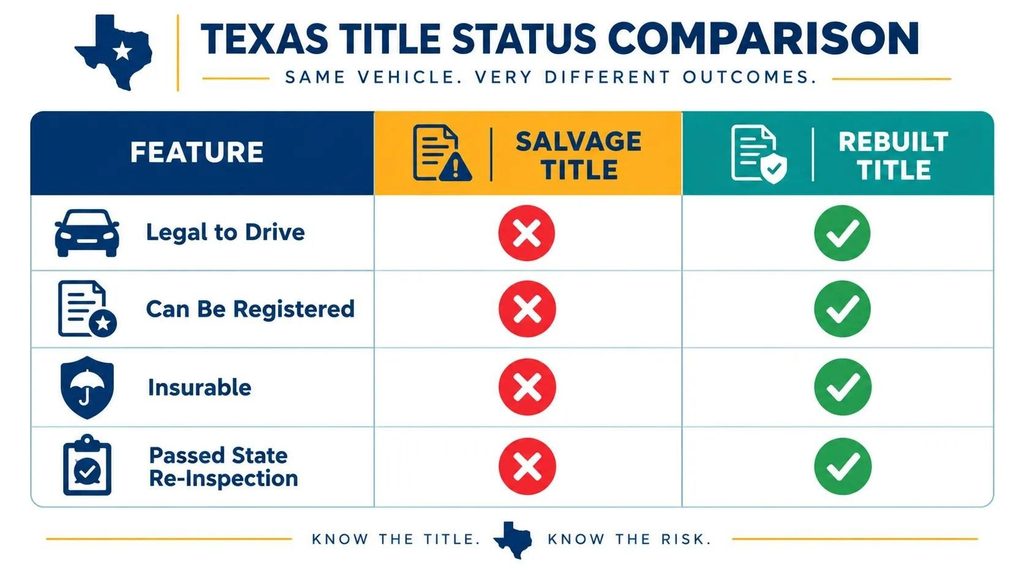
The Core Difference in One Table
| Factor | Salvage Title | Rebuilt Salvage Title |
|---|---|---|
| What it means | Insurance declared the vehicle a total loss. Repairs have not been completed or verified. | Previously salvage. Repaired and passed the required Texas state inspection to return to road use. |
| Legal to drive in Texas | No. Cannot be registered or driven on public roads in salvage status. | Yes. Road legal once the rebuilt title is issued. |
| Insurable | No. Cannot be insured while the title remains salvage. | Yes, but limited. Most standard carriers decline. Liability easier than full coverage. |
| Financing | Banks rarely finance a vehicle in salvage status. | Possible but harder. Higher rates and shorter terms are typical. |
| Value impact | Sells at auction typically for a fraction of clean-title value. | Roughly 20 to 40 percent below comparable clean-title value. |
| Texas inspection required | Not applicable until repairs are complete. | Yes. Includes a law enforcement check for stolen parts and VIN verification. |
| Resale outlook | Limited to parts buyers and rebuilders. | Sells, but the brand is permanent. Many dealers decline branded trade-ins. |
The single most important row is the first one. A salvage title describes a vehicle that was totaled. A rebuilt title describes a vehicle that was totaled and has since completed a documented repair and inspection process. The vehicle’s history is identical. Its legal status and roadworthiness verification are not.
How a Vehicle Gets a Salvage Title in Texas
An insurance company issues a total loss determination when the cost to repair a vehicle exceeds a threshold relative to its value.
That threshold varies by state. Texas law under the Transportation Code defines it as repair cost exceeding the vehicle’s actual cash value, though insurers in practice often total a vehicle when repairs reach roughly 70 to 100 percent of value. Some states use much lower thresholds – Iowa totals at 50 percent – which is why an identical accident can produce different title outcomes depending on where it happened.
Once totaled, the insurer typically pays the owner, takes possession of the vehicle, and sells it at auction through Copart, IAA, or a similar channel. Buyers at those auctions are usually rebuilders or parts operations. The title follows the vehicle as salvage from that point forward.
How Salvage Becomes Rebuilt in Texas
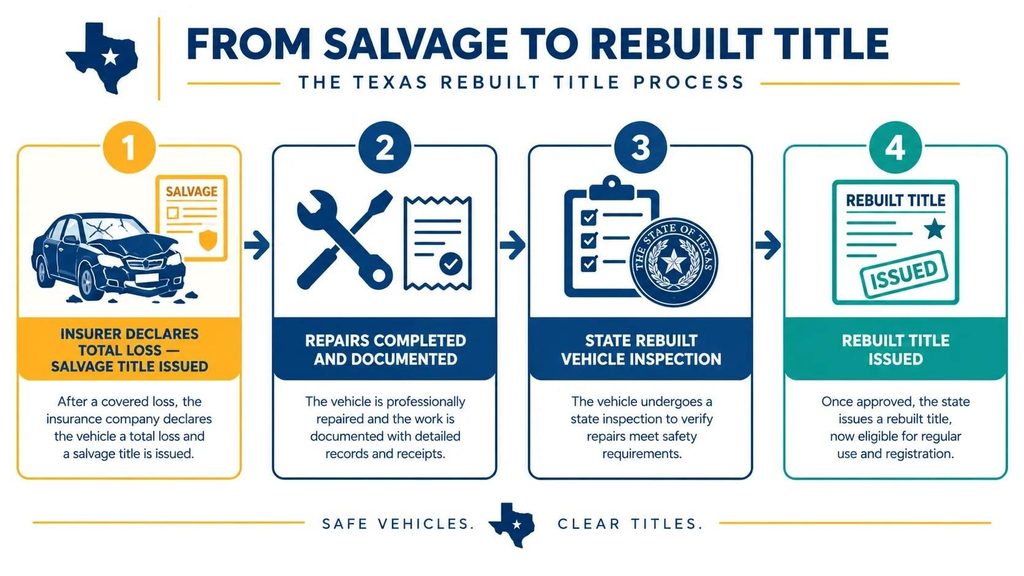
Converting a salvage title to a rebuilt title in Texas requires more than completing repairs. The state process includes a verification step that’s more rigorous than many buyers realize.
- The vehicle must be fully repaired to a roadworthy condition by the rebuilder
- A Rebuilt Vehicle Statement (form VTR-61) must be completed documenting the repairs performed and the parts used
- Supporting ownership and parts documentation must accompany the application – receipts for major components
- The vehicle undergoes a state inspection that includes a law enforcement check for stolen parts and verification of VIN placement and authenticity
- The complete application package is filed through the county tax assessor-collector office with the required fees
- If approved, the state issues a rebuilt title – permanently branded to show the vehicle was previously salvaged
The Texas Department of Motor Vehicles administers this process. The stolen parts and VIN verification component is genuinely useful to buyers – it means a Texas rebuilt title carries more verification weight than a rebuilt title from states with lighter requirements.
What the Rebuilt Title Does Not Tell You
Here is the critical limitation, and it’s the reason an inspection matters more on a branded-title vehicle than on any other purchase.
A rebuilt title confirms that a repair was completed and that the vehicle passed a state inspection focused on safety basics, stolen parts, and VIN integrity. It does not certify repair quality. It does not tell you whether the rebuilder used OEM structural components or the cheapest available salvage parts. It does not tell you whether the frame was properly straightened on a jig or approximately pulled back into shape.
Two vehicles with identical rebuilt titles can be entirely different purchases. One was professionally repaired by a shop with proper equipment and documented parts. The other was a quick flip with body filler over inadequate structural work. The title looks the same on both.
What to verify on any rebuilt title vehicle before buying:
- What caused the total loss – collision, flood, fire, or theft recovery each carry different long-term risk. Flood-related rebuilds carry the highest ongoing electrical failure risk
- Who performed the repair and whether documentation exists – a professional shop with parts receipts is materially different from an unnamed rebuilder
- Frame rail alignment and weld quality – improperly straightened structure affects crash performance and tire wear permanently
- Panel gap consistency compared side to side – inconsistent gaps indicate the repair did not restore original manufacturing tolerances
- Paint thickness readings across all panels – reveals how much filler was used and where
- Airbag system status via SRS module scan – deployed airbags must be properly replaced, and the module retains the deployment record
The Value and Insurance Reality
Branded titles carry a permanent financial cost that buyers should price in from the start.
Kelley Blue Book’s guidance for salvage, reconstructed, or otherwise clouded titles is to deduct roughly 20 to 40 percent from Blue Book value. Edmunds estimates a salvage history can reduce value by up to 50 percent compared to an identical clean-title vehicle. Flood-damaged vehicles typically sit at the deeper end of that range.
Insurance is the other practical constraint. Liability coverage on a rebuilt title vehicle in Texas is generally obtainable. Full comprehensive and collision coverage is significantly harder – most standard carriers decline rebuilt titles outright, and those that write the coverage typically charge 10 to 20 percent more. Verify insurability with your carrier before you buy, not after.
Financing is similarly constrained. Lenders view branded titles as higher risk because the collateral value is harder to establish and the resale market is smaller. Rates run higher and terms shorter when financing is available at all.
Title Washing: The Related Risk in Houston
There’s a fraud pattern adjacent to this topic that Houston buyers should understand.
Title washing is the practice of re-titling a branded vehicle in a state with weaker branding requirements to drop the brand, then bringing it back to a stricter state with an apparently clean title. It is fraud, and it’s a documented problem in Texas specifically because of the state’s high volume of post-storm flood vehicles.
Texas county clerks run NMVTIS – the National Motor Vehicle Title Information System – which flags prior total-loss records regardless of what the current paper title says. That catches many attempts. But it doesn’t catch everything, and a vehicle can change hands privately without ever reaching a clerk’s desk.
Run a free NMVTIS check at vehiclehistory.gov before purchasing any used vehicle. And on a Houston-area purchase specifically, a physical pre purchase auto inspection that includes a flood damage assessment catches what the paperwork misses – musty interiors, corroded seat rails, and wire harness damage that no title can hide.
So Should You Buy One?
A rebuilt title vehicle can be a legitimately good purchase. The discount is real, and a professionally repaired vehicle can serve reliably for years.
The decision comes down to three questions. What caused the original total loss? Who did the repair and can they document it? And what does a physical inspection say about the structural work?
The third question is the one you can control. For a rebuilt title purchase specifically, the expert vehicle inspection at $189.99 is worth the additional $30 over standard – the deeper documentation matters more when you’re evaluating repair quality rather than routine wear.
If the answers to all three questions are good and the discount is meaningful, a rebuilt title vehicle can work. If the seller is vague about any of them, the discount isn’t compensating you for the risk.
Frequently Asked Questions
What is the difference between a salvage title and a rebuilt title in Texas?
A salvage title means an insurance company declared the vehicle a total loss and repairs are not complete or verified – it cannot be legally driven, registered, or insured in Texas. A rebuilt salvage title means that vehicle was repaired and passed the required Texas state inspection, including a law enforcement check for stolen parts and VIN verification. A rebuilt title vehicle is road legal, registrable, and insurable, though with more limited options than a clean title.
Should I buy a car with a rebuilt title in Texas?
It depends on the repair quality and the discount. A rebuilt title is history, not a verdict on current condition. A professionally rebuilt vehicle with documented parts can be sound. A cosmetic flip with cheap parts is not. Because the title tells you nothing about repair quality, an independent pre purchase auto inspection is essential on any rebuilt title vehicle.
How much less is a rebuilt title car worth?
Industry guidance places the discount at roughly 20 to 40 percent below comparable clean-title value, with Edmunds estimating a salvage history can reduce value by up to 50 percent. Flood-damaged vehicles typically lose more than collision-repaired ones. The discount is permanent – the brand stays on the title for the life of the vehicle.
Can you insure a rebuilt title car in Texas?
Yes, but options are narrower. Most standard carriers decline rebuilt titles outright. Liability coverage is generally obtainable. Full comprehensive and collision coverage is harder to secure, and carriers that offer it typically charge 10 to 20 percent more. Verify insurability with your carrier before purchasing.
What should I inspect on a rebuilt title car before buying?
Focus on structural repair quality: frame rail alignment and weld quality, panel gap consistency, paint thickness readings showing filler use, airbag system status via SRS module scan, and evidence of the original damage type. Ask what caused the total loss – flood-related rebuilds carry the highest ongoing electrical risk. Call (346) 644-6168 or order an inspection online to have a rebuilt title vehicle assessed.
The Title Tells You History. The Inspection Tells You Condition.
On a rebuilt title vehicle, repair quality is everything – and it is the one thing the paperwork cannot certify. Pre Purchase Auto Inspections LLC assesses structural repair, paint thickness, and airbag status across the Houston metro.
Get a Pre Purchase Auto Inspection Today