
Electric Vehicle Inspection Houston: What EV Buyers Need to Know
|
Electric Vehicle Inspection Houston: What EV Buyers Need to Know
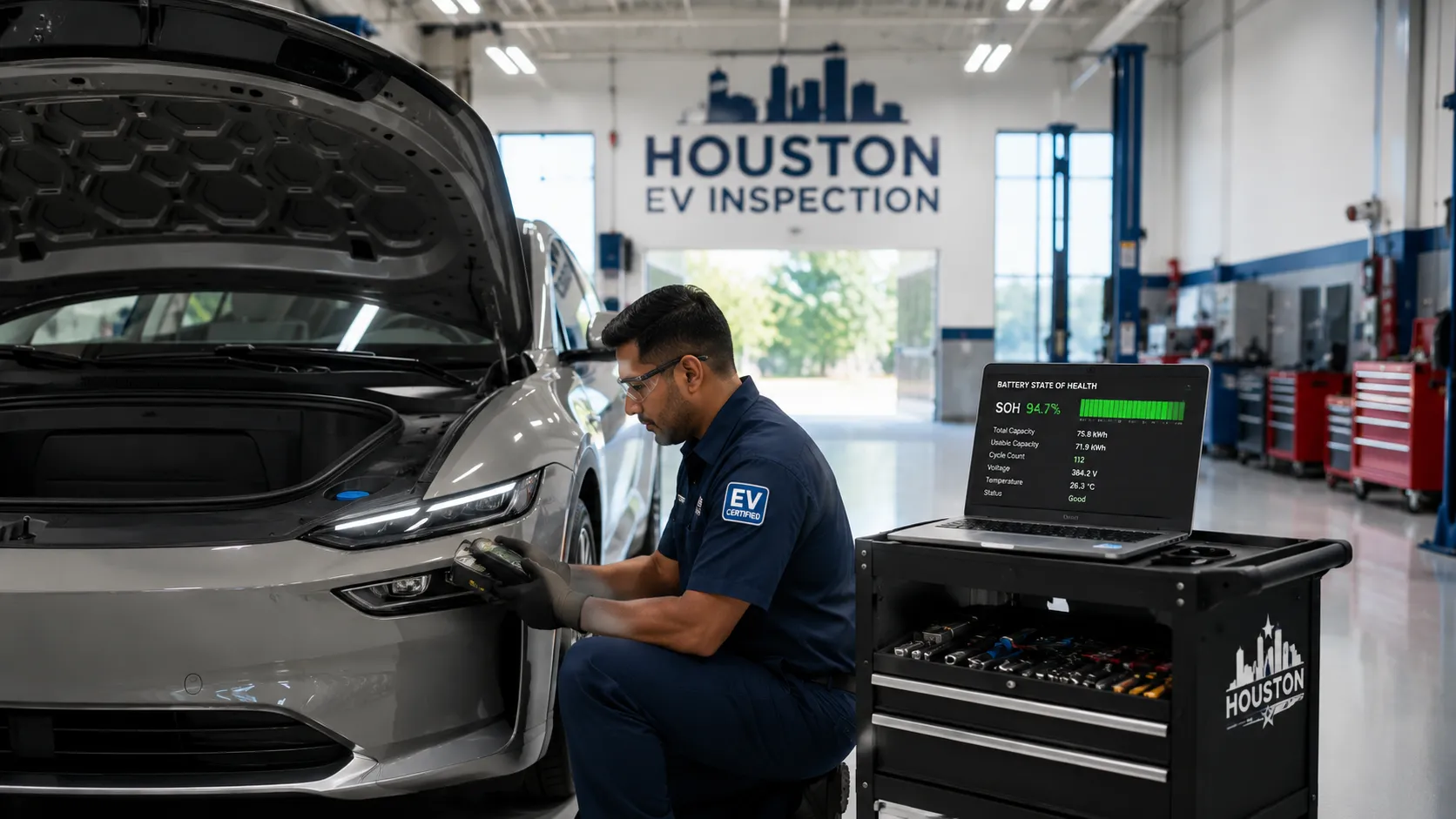
An electric vehicle inspection in Houston covers everything in a standard pre purchase check, plus battery State of Health, thermal management system condition, charging port integrity, and EV-specific module diagnostic scanning. These are the checks that determine whether a used EV is a smart buy or a six-figure liability. Pre Purchase Auto Inspections LLC performs dedicated EV inspections across the Houston metro at $249.95, mobile service included.
The used EV market in Houston is growing fast. Edmunds currently lists nearly 5,000 used electric vehicles for sale in the Houston area alone – Teslas, Bolts, Ioniq 5s, Rivians, and F-150 Lightnings ranging from $15,000 to $80,000. Before you buy any of them, you need an electric vehicle inspection houston – not a standard used car inspection.
The two are not interchangeable. A gas car inspection checks oil leaks, exhaust condition, transmission fluid, and emissions. None of that exists on an EV. What does exist is a 400-800 volt high-voltage battery pack that costs $6,000 to $25,000 to replace if something is wrong with it.
Here is exactly what an EV inspection covers, why Houston’s climate creates specific risks, and what the battery State of Health number means for your purchase decision.
| Standard Gas Car Inspection | Electric Vehicle Inspection (additional checks) |
| Engine oil and coolant condition | Battery State of Health (SoH %) via EV diagnostic |
| Transmission fluid and shift quality | Thermal management system – cooling and heating of battery pack |
| Exhaust system and emissions | DC charging port condition and connector integrity |
| Fuel system and injectors | Level 2 and DC fast charge functionality test |
| Timing belt/chain condition | High-voltage cable and connector safety check |
| Engine start and idle behavior | Battery management system (BMS) fault codes |
| Oxygen sensors and emissions data | DC fast charge history and frequency (affects degradation rate) |
| Standard OBD-II engine/transmission scan | EV-specific module scan including BMS, inverter, and charge control |
Pre Purchase Auto Inspections LLC performs dedicated electric vehicle inspection houston checks using EV-specific diagnostic equipment – not generic OBD scanners that stop at the powertrain module.
Battery State of Health – The Number That Changes Everything`
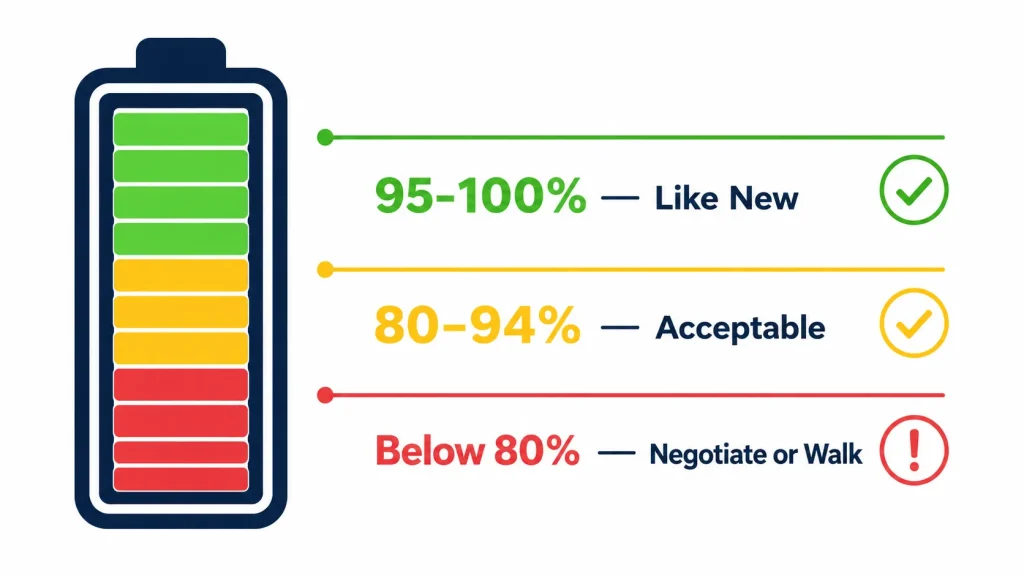
The single most important piece of information in any used EV purchase is the battery’s State of Health percentage. This tells you how much of the battery’s original capacity remains.
According to Recurrent Auto’s battery research, more than 85% SoH is generally healthy for a used EV purchase. Between 70% and 85% can be acceptable if the price reflects it and your range requirements are modest. Below 70% is typically a deal-breaker – that’s a 30% reduction in the range you’re paying for, and the degradation curve accelerates from there.
Why does this matter so much? Because the battery pack is the most expensive component on the vehicle, and it’s not covered by a standard repair warranty.
A used Tesla Model 3 listed at $24,000 with an 82% SoH battery is not the same vehicle as one at 91% SoH. The first one may need a $12,000 battery replacement within a few years. The second may go another decade without one. That difference doesn’t show up anywhere on the window sticker.
Houston-Specific EV Risks Every Buyer Needs to Know
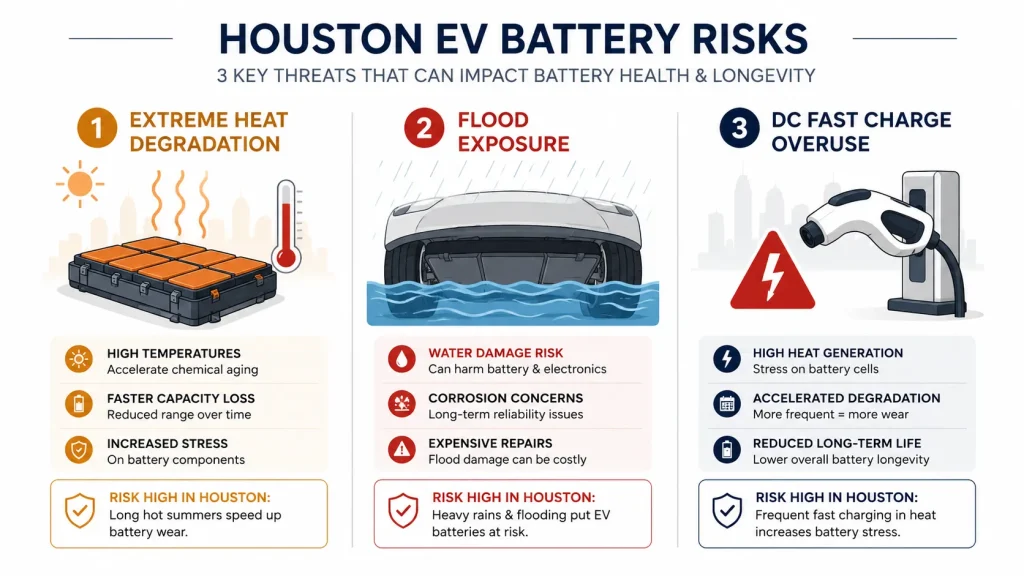
Houston creates two EV-specific risks that buyers in most other markets don’t face at the same scale.
The first is heat. Houston summers regularly exceed 95 to 100 degrees Fahrenheit for three to four months at a time. Lithium-ion batteries degrade faster in sustained high temperatures. An EV that was stored outdoors, charged in direct sun, or driven heavily during Houston summers without effective thermal management will show more capacity loss than the same vehicle from a cooler climate.
The specific risk is the thermal management system. Not all EVs have liquid-cooled battery packs. The original Nissan Leaf, for example, uses passive air cooling – which performed badly in hot markets and contributed to faster-than-average degradation in Texas. An inspection includes a check of the thermal management system’s condition and whether it’s functioning as designed.
The second risk is Houston’s flood history. A flooded EV is a fundamentally more dangerous problem than a flooded gas car.
High-voltage battery packs that have been submerged can develop internal short circuits that appear fine initially but fail weeks or months later. The high-voltage wiring harness and the thermal management system are both highly vulnerable to floodwater infiltration. The flood check on an EV inspection goes deeper than looking at carpet and undercarriage rust.
⦁ Battery pack undercarriage for dents, scrapes, or impact damage – the pack is floor-mounted and vulnerable to road debris and flooding
⦁ Thermal management system coolant lines for flood exposure or contamination
⦁ High-voltage connectors and cable insulation for corrosion or moisture ingress
⦁ Charge port for salt, debris, or corrosion consistent with flood exposure
⦁ BMS fault codes for any stored errors related to moisture, temperature extremes, or high-voltage faults
What the EV Diagnostic Scan Looks For
Standard OBD-II scanners connect to the same port on an EV as on a gas car – but they often can’t read the EV-specific modules that matter most. A proper EV inspection uses diagnostic software that communicates with the battery management system, the inverter module, and the charge control unit directly.
Here’s what the EV-specific scan checks for that a standard scan misses:
⦁ Battery management system (BMS) fault codes – stored errors indicating cell imbalance, temperature faults, or voltage anomalies
⦁ DC fast charge history – high-frequency DC fast charging degrades lithium batteries faster than Level 2 home charging; the BMS log often records this
⦁ Thermal management faults – any stored codes from the battery cooling or heating system
⦁ Inverter and motor controller faults – the high-voltage inverter is the EV equivalent of an engine control unit and can carry faults the dashboard never showed
⦁ Regenerative braking system function – confirmed during the road test by monitoring deceleration behavior and energy recovery readings
⦁ Cleared codes on EV modules – the same seller trick that applies to gas cars also applies to EVs; a recently cleared BMS is a red flag
The road test on an EV inspection also checks for specific EV behaviors: one-pedal driving response, regenerative braking strength, charging acceptance rate, and whether the vehicle enters any reduced-power or limp mode under normal driving conditions.
What About Hybrid and Plug-In Hybrid Vehicles
Hybrids and plug-in hybrids fall between a standard gas car inspection and a full EV inspection. They have both a combustion engine and a high-voltage battery system, and both need to be evaluated. Pre Purchase Auto Inspections LLC offers a dedicated hybrid vehicle inspection that covers both systems at $249.95.
The hybrid battery pack is generally smaller and less expensive to replace than a full EV pack, but it still carries significant risk if it’s been degraded or is approaching end of life. The inspection checks battery balance, hybrid system fault codes, and electric motor health alongside the standard engine and drivetrain checks
Frequently Asked Questions
Does an electric vehicle inspection in Houston cost more than a standard inspection?
Yes. An electric vehicle inspection at Pre Purchase Auto Inspections LLC is $249.95 compared to $149.95 for a standard inspection. The higher price reflects the EV-specific diagnostic equipment, battery State of Health evaluation, thermal management system check, and charging system testing that a gas car inspection does not require.
What does battery State of Health mean on an EV?
State of Health, or SoH, is a percentage showing how much of the battery’s original capacity remains. Above 85% is generally healthy for a used purchase. Between 70% and 85% can be acceptable if the price reflects the reduced range. Below 70% is typically a deal-breaker – range loss is significant and out-of-warranty battery replacement costs range from $6,000 to $25,000 depending on the vehicle.
Can Houston heat damage an EV battery before I buy it?
Yes. Lithium-ion batteries degrade faster in sustained high temperatures. Houston summers regularly push 95 to 100 degrees for months at a time. EVs stored, charged, or driven heavily in Houston without an effective thermal management system show faster battery capacity loss than the same vehicle from a cooler market. The inspection checks thermal management system function and reviews BMS data for temperature-related fault history.
How do I book an electric vehicle inspection in Houston?
Call (346) 644-6168 or order an inspection online at prepurchaseautoinspectionsllc.com. We come to the vehicle’s location anywhere across the Houston metro including Katy, Sugar Land, Pearland, The Woodlands, and Pasadena. Same-day scheduling is available on most requests.
Get Your Houston EV Inspection Booked
Pre Purchase Auto Inspections LLC performs dedicated electric vehicle inspections across the Houston metro – Katy, Sugar Land, Pearland, The Woodlands, Pasadena, and beyond. We come to the vehicle. You get a full EV report the same day.
(346) 644-6168 | order an inspection online
Electric Vehicle Inspection: $249.99 | Hybrid Vehicle Inspection: $249.99 | Mobile service – we come to the car
Get a Pre Purchase Auto Inspection Today