
How to Avoid Odometer Fraud When Buying a Used Car
|
How to Avoid Odometer Fraud When Buying a Used Car in Texas
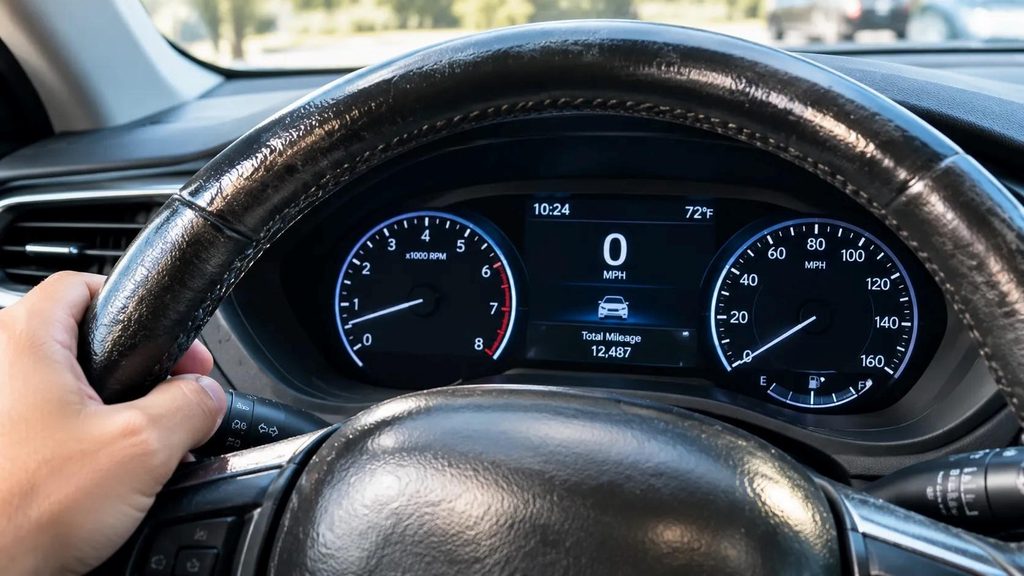
To avoid odometer fraud, cross-check three independent sources: the vehicle history report mileage timeline, the physical wear on the vehicle, and service records or inspection stickers. Physical wear that does not match claimed mileage is the most reliable indicator – a polished steering wheel and collapsed driver seat bolster do not belong on a car showing 40,000 miles. NHTSA estimates 450,000 vehicles with rolled-back odometers are sold in the US annually.
Odometer fraud is getting worse, not better. CARFAX data shows roughly 2.45 million vehicles currently on US roads are suspected of having had their odometers rolled back – a 14 percent jump from the prior year. NHTSA estimates around 450,000 vehicles with false readings are sold annually, costing consumers over $1 billion.
Texas is consistently among the states with the highest fraud rates, alongside California, Florida, New York, and Illinois. High-volume used car markets attract this specific fraud because the profit is straightforward and the detection risk is low.
Here is how rollback actually works now, and the three checks that catch it.
Digital Odometers Made This Easier, Not Harder
The most persistent misconception about odometer fraud is that digital dashboards solved it. They didn’t. They changed the tooling.
Rolling back a mechanical odometer required physically accessing the instrument cluster, running the gears backward, or swapping in a cluster from a salvage vehicle. It took time and left evidence – misaligned digits, scratched cluster housing, mismatched trim.
Rolling back a digital odometer requires an OBD-II device and software that’s commercially available and, in some jurisdictions, legal to sell. The process overwrites the mileage stored in the vehicle’s electronic control unit. It takes minutes and leaves no physical trace whatsoever on the dashboard.
That’s why detection has shifted entirely away from examining the odometer itself. What catches rollback now is the mismatch between what the number says and what the rest of the car says.
Check 1: Physical Wear Against Claimed Mileage
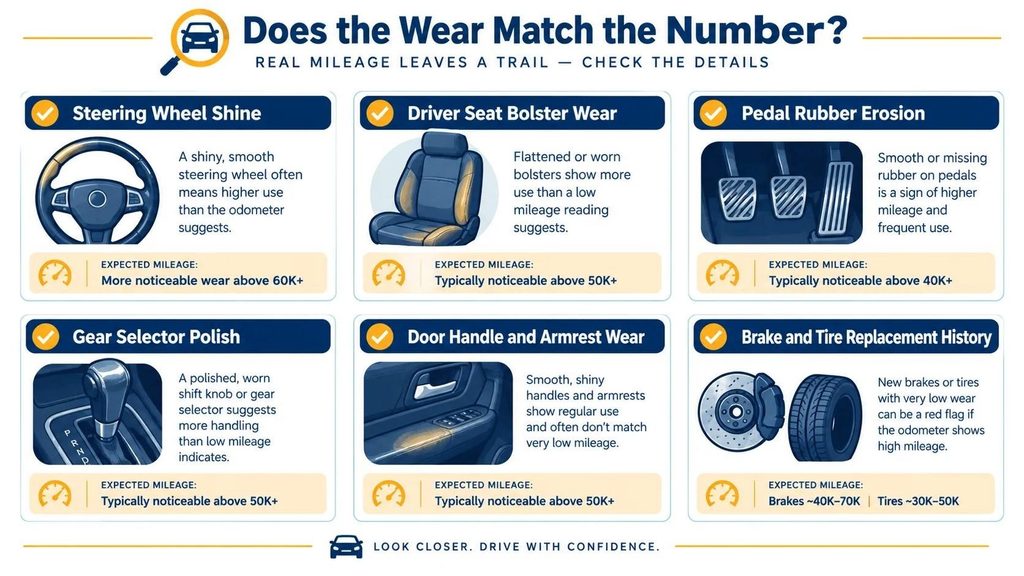
This is the most reliable single method, and it requires no tools or subscriptions.
A vehicle accumulates wear in specific, predictable places. Every mile driven means one more press of the brake pedal, one more grip of the steering wheel, one more entry and exit compressing the driver’s seat bolster. That wear can’t be rolled back with software.
| Component | Expected at 40,000 Miles | Red Flag If You See |
|---|---|---|
| Brake pedal pad | Rubber texture still visible, minimal smoothing | Worn smooth or replaced pedal pad on a claimed low-mileage car |
| Steering wheel | Original texture intact, no shine on the grip areas | Polished shine at 10 and 2 positions, or a fitted cover hiding wear |
| Driver seat bolster | Minimal compression, fabric or leather grain intact | Collapsed side bolster, cracked leather, or visible seat wear pattern |
| Tires | Often still original equipment tires with tread remaining | Second or third set of tires – check DOT date codes against claimed mileage |
| Gear selector and controls | Lettering crisp, no polish on frequently touched surfaces | Worn lettering on the shifter, window switches, or turn signal stalk |
| Floor mats and pedals | Light wear pattern under the driver’s heel | Heel-worn carpet through to backing, or brand-new mats hiding it |
| Service stickers | Oil change sticker mileage progression should be logical | Sticker showing higher mileage than the odometer currently reads |
The bottom row is worth checking first because it’s fast and often overlooked. Oil change stickers in the windshield corner or door jamb record mileage at the time of service. A sticker showing a higher figure than the odometer currently displays is direct, physical, documented evidence of a rollback.
Watch for concealment as well. A brand-new steering wheel cover, replaced floor mats, or a recently swapped brake pedal pad on an otherwise unremarkable car are worth a second look. These are cheap items that get replaced specifically to hide the wear that would contradict the odometer.
Check 2: The Vehicle History Report Timeline
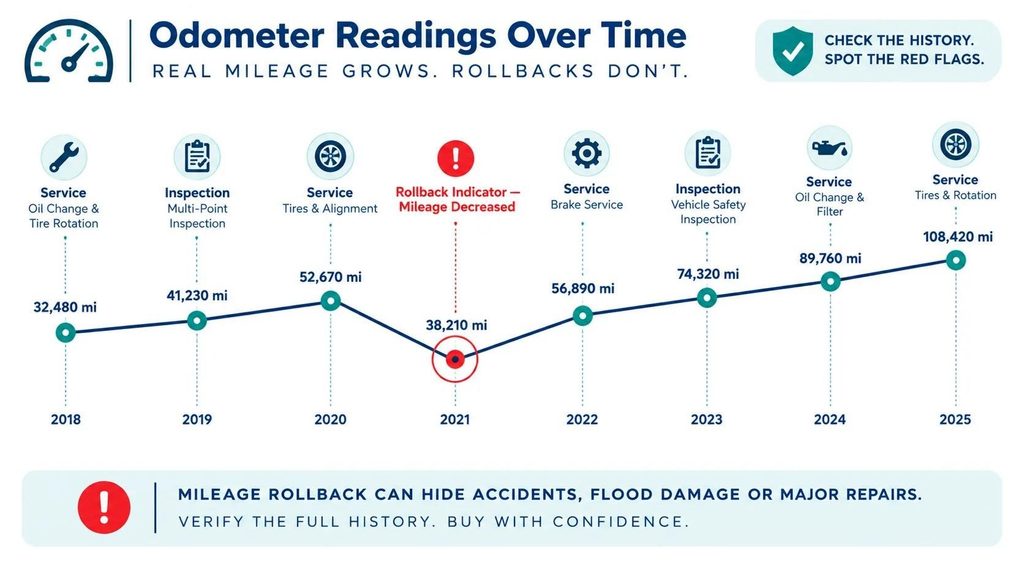
CARFAX and AutoCheck record odometer readings from DMV registrations, insurance records, service shops, and dealer transactions. When a later reading is lower than an earlier one, they flag it as a discrepancy.
That’s useful, and you should always run a report. But understand its limitation: a rollback performed between two recorded readings can go entirely undetected as long as the next reported figure is still higher than the previous one.
Here is what to look for in the mileage timeline beyond an explicit rollback flag:
- Long gaps between recorded readings – a vehicle with no mileage entries for three years has a window where a rollback would not be caught by the report
- Implausible annual mileage – the US average is roughly 13,500 miles per year. A vehicle averaging 3,000 miles annually is possible but unusual enough to verify against physical wear
- Multiple state transfers in a short window – moving a vehicle between states resets the documentation trail and is a known method for obscuring mileage history
- A reading that jumps dramatically then flattens – a large mileage increase followed by minimal accumulation can indicate the vehicle was rolled back and then driven lightly to avoid a visible discrepancy
Run a free NMVTIS check at vehiclehistory.gov as well. It won’t catch every case, but it’s a zero-cost addition to the routine and draws on federal title data.
Check 3: Service Records and the Inspection
Service records are the third independent data source, and they’re often the most detailed.
Dealer service records, independent shop invoices, and even tire shop receipts typically record the odometer reading at time of service. A complete service history creates a mileage timeline that a rollback has to fit inside – and frequently doesn’t.
Ask the seller for service records directly. A seller who has them and provides them readily is demonstrating good faith. A seller who says they’ve lost them on an otherwise well-presented vehicle is worth additional scrutiny, particularly if the claimed mileage is low.
A professional pre purchase auto inspection adds the mechanical dimension to this assessment. An inspector evaluating brake wear, suspension bushing condition, transmission fluid, and belt condition against a claimed 40,000 miles will identify immediately when the wear pattern belongs to a vehicle with three or four times that figure.
The OBD-II scan contributes too. Many modern vehicles store mileage data in multiple modules, not just the instrument cluster. A rollback performed on the cluster alone can leave contradictory figures in the engine control module or transmission control module – which a full multi-module scan surfaces.
What Odometer Fraud Actually Costs You
CARFAX puts the average overpayment at approximately $4,000 per affected vehicle. That figure understates the real cost.
Consider a 2013 Camry with 200,000 actual miles rolled back to show 100,000. The price difference between those two versions of the same car is roughly $4,000 – that’s the direct overpayment. But the buyer also inherits 100,000 miles of unbudgeted maintenance timing.
The timing belt they thought was 40,000 miles away is overdue. The transmission service they budgeted for next year should have happened two years ago. Suspension components, water pump, and other mileage-based items all arrive earlier and in worse condition than planned. The $4,000 overpayment is the opening cost, not the total.
For higher-value purchases where the mileage claim materially affects the price, the expert vehicle inspection at $189.99 adds extended diagnostics and deeper documentation of the wear-versus-mileage assessment.
If You Suspect Fraud After Buying
Odometer tampering is a federal crime under 49 U.S.C. § 32703, and Texas law requires accurate mileage disclosure at sale.
If you discover a rollback after purchase, preserve everything: the purchase contract, bill of sale, title, the vehicle history report showing the discrepancy, any service records contradicting the reading, and photographs of the physical wear. Report it to NHTSA and the Texas Attorney General’s consumer protection division.
The stronger position, obviously, is catching it before the money changes hands. All three checks in this guide happen before purchase and cost between nothing and $149.95.
Frequently Asked Questions
How do I avoid odometer fraud when buying a used car in Texas?
Cross-check three independent sources: the vehicle history report mileage timeline, the physical wear on the car, and service records or inspection stickers. Physical wear that does not match claimed mileage is the most reliable indicator – a worn steering wheel, smoothed brake pedal, and collapsed driver seat bolster do not belong on a car showing 40,000 miles. Also check oil change stickers, which sometimes show higher mileage than the odometer reads.
Can digital odometers be rolled back?
Yes, and more easily than mechanical ones. Digital tampering requires only an OBD-II device and commercially available software that overwrites the mileage stored in the vehicle’s electronic control unit. The process takes minutes and leaves no physical trace on the instrument cluster. Detection relies on external records and physical wear rather than examining the odometer.
How common is odometer fraud?
NHTSA estimates roughly 450,000 vehicles with rolled-back odometers are sold in the US each year, representing approximately $1 billion in consumer losses. CARFAX data indicates around 2.45 million vehicles currently on US roads are suspected of rollback – a 14 percent increase over the prior year. Texas is consistently among the highest-fraud states.
Does a vehicle history report catch odometer fraud?
Sometimes but not always. CARFAX and AutoCheck flag mileage discrepancies when a later reading is lower than an earlier one. But a rollback performed between recorded readings can go undetected if the subsequent mileage is still higher than the previous entry. Vehicles moved across state lines to reset the documentation trail are harder to track. Physical wear assessment matters alongside the report.
What does odometer fraud cost the buyer?
CARFAX data puts the average overpayment at approximately $4,000 per vehicle. But the direct overpayment is only part of it – a vehicle with 200,000 actual miles showing 100,000 also carries 100,000 miles of unbudgeted maintenance timing. Call (346) 644-6168 or order an inspection online to have wear assessed against claimed mileage before you buy.
Verify the Mileage Before You Pay for It
Pre Purchase Auto Inspections LLC assesses mechanical wear against claimed mileage on every inspection – the check that catches what the odometer and the history report both miss. Mobile service across the Houston metro.
Get a Pre Purchase Auto Inspection Today